

7 Things Every Woman Should Know Before Spending Another Dollar On Her Under-Eyes
You’ve tried. Creams, serums, patches, maybe fillers, maybe just better concealer. But what if the reason nothing has permanently worked has nothing to do with the products — and everything to do with a biological barrier nobody told you about?

Know Why Nothing You’ve Tried Has Produced Lasting Results
It doesn’t matter whether you’ve spent $50 or $5,000 on your under-eyes.
It doesn’t matter whether you went the skincare route, the filler route, or the “just accept it and buy better concealer” route.
If you’re reading this, the result was the same. Temporary improvement at best. Nothing structural. Nothing permanent. Nothing that made someone look at your bare face and say “you look amazing” without you fishing for the compliment.
There’s a reason for that. And it’s not what anyone in the beauty industry or aesthetics industry has told you.
There’s a rule in transdermal science called the 500-Dalton rule.
For any ingredient applied to your skin to actually penetrate through the outer barrier and reach the living tissue underneath, its molecular weight must be below 500 Daltons.
Above 500 Daltons? It sits on the surface. It hydrates. It temporarily plumps. It might feel wonderful. But it cannot physically reach the dermis where collagen is produced, where blood vessels form, where the actual structural damage is happening.
The skin under your eyes is 0.5mm thick. The thinnest on your entire body. No oil glands. Minimal fat padding. Almost zero margin for error.
And almost everything you’ve ever applied to it was too large to get through the door.
This isn’t a theory. The 500-Dalton rule is published, peer-reviewed, and accepted in transdermal pharmacology.
Once you understand it, everything about your experience starts to make sense. And everything the industry has sold you starts to fall apart.
For any ingredient to penetrate the skin barrier and reach living tissue, its molecular weight must be below 500 Daltons. Hyaluronic acid: over 1,000,000 Da. Most peptides: 500–2,000 Da. PDRN fragments: below 500 Da.
Understand That Every Approach You’ve Tried Falls Into Three Dead-End Categories
Strip away the brand names. Ignore whether it came in a jar, a syringe, or a tube. Look at what every under-eye solution is actually doing at a biological level.
They all fall into three categories.
Hydration
Pull water to the surface. Temporary plumpness. Gone in hours. This is what every hyaluronic acid serum, every moisturizing eye cream, every hydrating patch is doing. Surface-level water retention dressed up as “anti-aging.”
Vasoconstriction
Temporarily shrink blood vessels so dark circles look lighter for 30–60 minutes. Caffeine serums, cold compresses, green tea extracts. The blood vessels relax. The darkness returns. Every single time.
Volume Displacement
Hyaluronic acid fillers physically push the hollow area outward with injected gel. The gel dissolves over 6–12 months. The hollow returns. Over time, repeated filler can stretch tissue, creating MORE volume loss.
Three strategies. Every product, every treatment, every procedure you’ve tried is a variation on one of these three.
None of them can regenerate tissue. None of them can repair the cellular damage that’s causing your under-eyes to thin, hollow, and darken year after year.
The game was rigged before you started. You just couldn’t see the pattern until now.
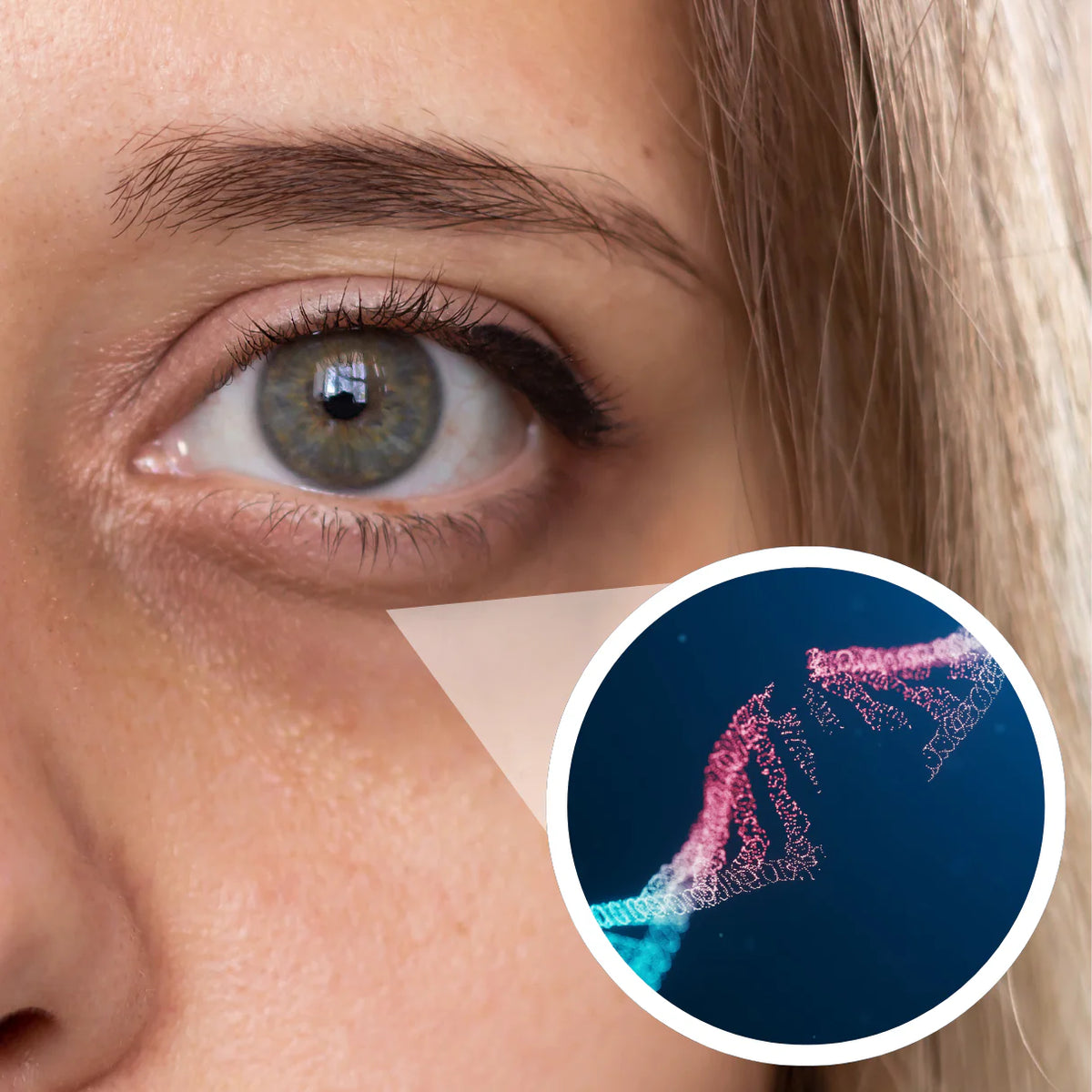
Recognize That Your Under-Eyes Aren’t Just Aging — They’re Declining At The Cellular Level
This isn’t just about looking older. Something is actively breaking down.
The cells under your eyes — your fibroblasts — are the ones responsible for producing collagen, elastin, and the structural proteins that keep skin thick, firm, and resilient.
After years of UV exposure, oxidative stress, hormonal shifts, and the mechanical stress of blinking over 10,000 times per day, those cells are damaged. Their DNA has accumulated errors.
Damaged fibroblasts don’t die. They keep working. But at a fraction of their capacity.
Research shows damaged fibroblasts produce collagen at roughly 18–24% of normal output.
That’s why your under-eye skin is thinning. That’s why hollows are deepening. That’s why dark circles intensify as veins become more visible through increasingly transparent skin. That’s why you look more tired every year even when nothing else about your health or sleep has changed.
And here’s what nobody tells you. This doesn’t plateau. It accelerates.
The inflammation compounds. The collagen deficit grows. The skin gets thinner. The damage feeds more damage.
Whatever you’re seeing in the mirror right now? It will be worse in 12 months if the underlying cellular damage isn’t addressed.
Not managed. Not concealed. Not temporarily filled.
Addressed.
Whatever you’re seeing in the mirror right now? It will be worse in 12 months if the underlying cellular damage isn’t addressed.

Stop Spending Money On Approaches That Can’t Fix The Root Cause
Let’s be honest about what you’ve spent.
Whether it’s $200 on eye creams that promised “visible results in 2 weeks.” Or $1,200 on tear trough filler that dissolved in 8 months. Or $60 on concealers you layer every morning just to look normal. Or $4,000 you’ve been considering for surgery.
The money is real. The time is real. The disappointment is real.
And the results? Temporary at best. Nonexistent at worst.
Here’s why.
Every one of those approaches is either trying to hydrate the surface, constrict blood vessels for a few minutes, or physically displace volume with injected gel.
Not one of them can repair damaged fibroblasts. Not one of them can restore collagen production at the cellular level. Not one of them addresses WHY your under-eyes are deteriorating.
They treat what you see. They can’t fix what’s causing it.
The root cause is cellular damage. DNA-level impairment in the cells responsible for maintaining the structure of your under-eye skin.
Until that damage is repaired, everything else is a band-aid. An expensive, frustrating, temporary band-aid.

Know What PDRN Is And Why It’s Not Like Anything You’ve Tried Before
PDRN — Polydeoxyribonucleotide — isn’t a new trendy ingredient.
It’s been used in clinical medicine since 1994. Thirty years. Approved in Italy, South Korea, and Japan for wound healing, burn treatment, and tissue regeneration.
Surgeons use it to restart the repair process in tissue that has essentially given up on healing itself.
Over 80 peer-reviewed studies on PubMed. Not brand-funded marketing studies. Independent research from university hospitals across multiple countries.
Here’s what makes it different from everything in the three dead-end categories.
It’s small enough to get through the door
PDRN fragments fall below the 500-Dalton threshold. Unlike hyaluronic acid, unlike most peptides, unlike the larger polynucleotide (PN) molecules, PDRN fragments can actually pass through the skin barrier and reach the dermal tissue where the damage lives.
It targets damaged cells specifically
PDRN binds to A2A adenosine receptors that are highly expressed only on damaged fibroblasts. Healthy cells barely respond. Damaged cells respond strongly. It goes exactly where it’s needed.
It triggers actual DNA repair
Your cells use the PDRN fragments as raw building blocks to repair their own damaged DNA through the salvage pathway. Once repaired, fibroblasts resume normal collagen production at full capacity.
340% increase in collagen synthesis from PDRN-treated fibroblasts versus untreated controls. This isn’t a fourth version of the same three strategies. It’s an entirely different category. This is tissue regeneration.
Look At The Evidence — Real Evidence, Not Marketing
You’ve been lied to by “clinical studies” before.
“In a 4-week study, 87% of women agreed their under-eyes looked brighter.”
That’s a self-assessment survey. The placebo response rate in skincare studies is 30–40%. Give 100 women a jar of plain moisturizer and tell them it contains a breakthrough ingredient. Roughly 35 will sincerely report visible improvement.
You can’t trust what people say they see. You can trust what instruments measure.
PDRN was studied with objective measurements. Instruments, not opinions.
You can’t placebo your way into measurable tissue density changes on an ultrasound. Either the dermis got thicker or it didn’t. The machine doesn’t care what anyone hoped would happen.
And the most telling result of all? The majority of study participants who had been scheduled for filler injections or surgical consultations cancelled those appointments after completing the PDRN protocol.
People don’t cancel procedures they’ve already booked, researched, and put deposits on unless the results from the alternative are undeniable.
That’s not a survey response. That’s a high-stakes behavioral decision that tells you more about efficacy than any percentage ever could.
Know Exactly What To Look For (Because Most PDRN Products Won’t Work Either)
This is the part that saves you from wasting more money.
PDRN is gaining popularity. Which means the market is already flooding with products that use the name without delivering the science.
“Salmon DNA” serums. “Polynucleotide” essences. “PDRN-infused” eye creams. They’re everywhere now. Most of them won’t do a thing.
Here’s why.
Concentration: 500+ ppm
The clinical research used 500+ ppm. Most consumer products use 50–100 ppm to keep costs down. Some don’t list concentration at all. If it’s not on the label, it’s not in the jar. Move on.
PDRN, not PN
Polynucleotides (PN) are larger molecules — 700+ kDa. Too big to penetrate topically. Many “salmon DNA” products use PN, not PDRN. Different molecule. Different size. Different result.
Hydrogel patch delivery
Creams evaporate. Serums migrate into your eyes. Patches create a sealed occlusive environment. 20–30 minutes of uninterrupted delivery. Change the delivery method, lose the results.
Three variables need to align. Clinical-grade concentration. Actual PDRN fragments. Hydrogel patch delivery.
Remove any one of those three and you’re outside the parameters of the published research.
You’re guessing again. And you already know what guessing gets you.
The Clarae PDRN Eye Patches
One patch. 20–30 minutes. Three times a week.
End your under-eye frustration within 8 weeks. Join the women who’ve already stopped searching.
TRY NOW — SALE IS LIVELimited stock available. Demand has increased significantly since PDRN research went mainstream.

What Women Are Saying
Frequently Asked Questions
Most women notice initial changes around weeks 2–3. Reduced puffiness. Subtle brightening. Skin that feels slightly denser. The meaningful structural improvement typically becomes visible around weeks 5–8. This is tissue regeneration, not temporary plumping. Commit to the full protocol before judging.
Dark circles have multiple causes. If yours are primarily vascular — blue-purple tone from blood vessels showing through thin skin — PDRN addresses this through increased dermal density (thicker skin masks vessels) and A2A receptor activation (promotes healthier blood vessel formation). The clinical research showed a 47.94% reduction in periorbital pigmentation.
Yes. PDRN patches work on the skin and dermal tissue, not the deeper fat pad layer where filler sits. Many women use them alongside existing filler to improve skin quality. Some use them as a transition strategy — maintaining patches while letting filler dissolve naturally.
Yes. PDRN patches don’t replace your routine. They address the one gap your routine structurally can’t fill. Apply to clean, dry skin for 20–30 minutes before layering the rest of your products. One variable added. Everything else unchanged.
The clinical research used hydrogel patch delivery. Patches create a sealed occlusive environment for sustained direct contact. No evaporation. No migration. No disruption from layering. Changing the delivery format means you’re no longer replicating the methodology that produced the published results.
Check three things. Concentration: ours is 500+ ppm, most are 50–100. Molecule: ours is actual PDRN fragments, not larger PN molecules. Delivery: hydrogel patches, not cream or serum. If a competing product matches all three specs, buy it. We’re confident because we haven’t found one that does.
30-day money-back guarantee. Full refund. No survey. No “store credit only.” No games. If you don’t see improvement, you get your money back.
PDRN has been used in clinical medicine since 1994 with an excellent safety profile. It’s biocompatible with human tissue. If you have active eczema, psoriasis, or broken skin in the under-eye area, wait until resolved. If pregnant or nursing, consult your doctor. The hydrogel formula is fragrance-free, paraben-free, and formulated at pH 5.5–6.0.
Your Under-Eyes Have Been Telling You Something.
The thinning. The hollowing. The darkness that gets worse every year. It wasn’t your fault. The products couldn’t do what they promised. The barrier wouldn’t let them through. There’s a way through now.
TRY PDRN PATCHES — SALE IS LIVEFree shipping · Subscribe & save 15%
Results vary by individual based on skin type, severity of concern, and consistency of use. PDRN has been used in clinical medicine since 1994 and is generally well-tolerated. Clinical data referenced on this page is drawn from peer-reviewed research available on PubMed. This is not medical advice. Consult your dermatologist with specific concerns.