
I Study Facial Volume Loss for a Living. Here Are the 7 Things You Were Never Told.

A Korean formulation scientist explains why the hollow under your eyes keeps coming back — and why everything the Western beauty industry has sold you to fix it was never designed to work.
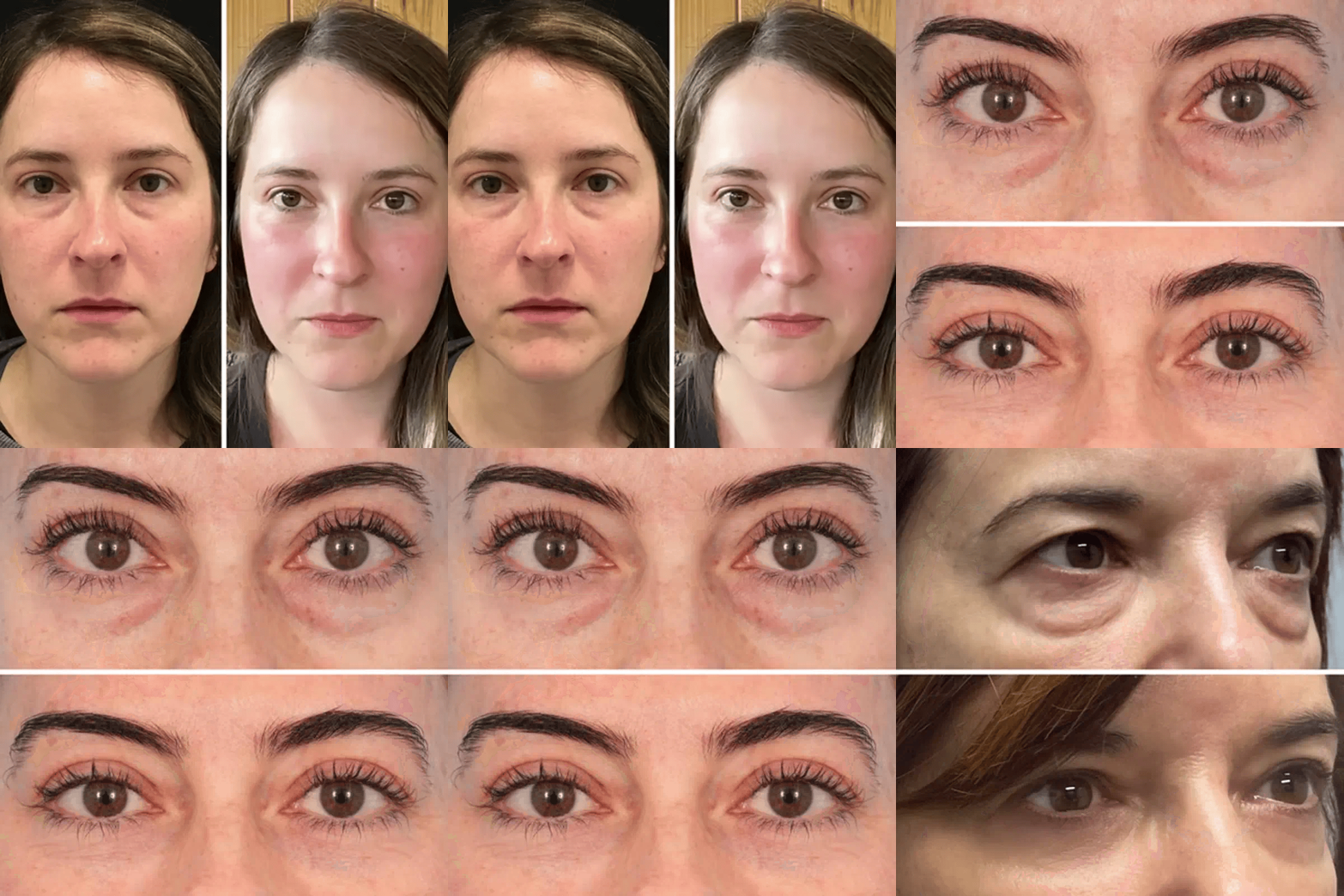
“The hollow under your eye is not a skin problem. It is not a pigment problem. It is not a hydration problem. It is a structural problem — and it lives in a completely different anatomical layer than everything you have been sold to fix it.”

The shadow under your eyes is not dark circles. It is a hollow — and that distinction changes everything.
Most women who come to Korean aesthetic clinics describing “dark circles” do not have dark circles. They have hollows. These are two completely different problems with two completely different causes — and the entire Western eye cream industry is built on treating one while calling it the other.
Dark circles are a pigmentation issue. The skin itself has discoloration. Brightening ingredients, vitamin C, niacinamide — these address pigmentation. They are the right tools for the right problem.
A hollow is structural. There is literally less volume beneath the skin than there used to be. The shadow you see is not the skin being dark — it is the shadow cast by the absence of tissue underneath it. You can layer concealer on top of that shadow every day for the rest of your life. The shadow will still be there when you take it off.
This is why your concealer stopped working the way it used to. It is not the concealer. It is the structure underneath.

Your face has a layer of fat cells that give it its shape. When those cells go quiet, the face deflates.
Beneath your skin — below the dermis, in a structurally separate anatomical zone — there are fat pads. Small compartments of fat cells positioned at your cheekbones, under your eyes, around your lips, at your temples. These fat pads are not just tissue. They are architecture. They are what makes a face look three-dimensional rather than flat.
Think of it this way. A peach does not wrinkle first. When the flesh beneath the skin loses its fullness, the skin above it simply follows — softening, settling, no longer held up by what was underneath. The skin itself is still fine. It is what is beneath it that went quiet.
What you are watching happen to your face is the same thing. Not wrinkling. Deflating. The structural filling beneath the surface is emptying — and the skin above it has nothing to rest on anymore.
This is why the face can change so dramatically without the skin itself changing much at all. Women often tell me their skin is fine. Their texture is good. Their hydration is good. But their face looks completely different from two years ago. The skin is fine. The structure underneath went quiet.
“There are no wrinkles on a beach ball until you let the air out. What is happening to your face is not aging. It is deflating.”

The cells are not gone. They went dormant. This changes what is possible.
This is the most important thing I will tell you in this article. Please read it slowly.
The fat pad cells that gave your face its shape did not die. They did not disappear. They stopped receiving the biological signal that told them to stay full and functional — and so they went dormant. They are still there. They are waiting.
In Korea, we made a clinical distinction between fat pad atrophy (the cells are gone) and fat pad dormancy (the cells stopped functioning) many years ago. This distinction is critical because it completely changes what is possible with treatment. You cannot restore what is gone. But you absolutely can reactivate what has gone quiet.
Estrogen is one of the primary biological signals that tells fat pad cells to stay full and functional. When estrogen levels drop — which happens rapidly in perimenopause, after significant weight loss, after pregnancy, as a side effect of certain medications — the cells stop receiving that instruction.
This is why the change often feels sudden. Women describe it as a cliff, not a slope. One year the face looks familiar. The next year it does not. The signal dropped. The cells went quiet. The face deflated. All within months.

Eye creams cannot physically reach the layer where the problem lives. This is not an opinion. It is anatomy.
I say this without any criticism of the products themselves. Many Western eye creams are formulated with excellent ingredients. They do real things — they hydrate, they reduce inflammation, they signal collagen production in the dermis. For what they are designed to do, they work.
They are not designed to reach the subcutaneous fat layer. That layer sits approximately 1.5 millimeters below the base of the dermis — a distance that water-based topical formulations simply cannot cross. This is not a formulation limitation that can be engineered around with better peptides or a higher price point. It is the anatomy of skin. The layers do not allow it.
When a patient in our clinic asks me why her luxury eye cream is not fixing her hollows, I do not tell her the product is bad. I tell her she has been trying to fix a structural problem with a surface tool. The right ingredient in the wrong layer produces no result. Every time.
This is also true for retinol, for vitamin C, for hyaluronic acid serums, for under-eye patches. All of them operate at the skin level. None of them were built to reach the fat pad. The problem was never in their reach.
The formulation that reaches the fat pad layer is now available outside a clinical setting.
Korean-formulated. 5% Volufiline + Salmon PDRN. Applied at home in 30 seconds.

In Korea, we have been using a specific molecule to signal dormant fat pad cells for over a decade. It has not reached Western products yet.
The ingredient is called Volufiline. It is a patented lipid compound — not water-based, which is why it can reach the fat pad layer when water-based serums cannot. It binds to lipid receptors on fat pad cells and activates the biological pathway that tells those cells to increase in volume and density.
It does not add a foreign substance to your face. It does not fill the space with something that does not belong there. It sends the signal that the cells stopped receiving — and they respond.
In a 56-day clinical study, Volufiline at 5% concentration produced measurable structural volume gain in all participants — documented by ultrasound imaging, not self-reported feeling. The mean gain was 2.2%. The top-responding quarter showed 8.4% structural increase.
For context: one round of hyaluronic acid filler typically delivers 1–3% measurable volume. The top-responding Volufiline users achieved that — without a needle, without a clinic, over 56 days at home.
Most Western products that list Volufiline on their label include it at 0.5% to 1% — enough to claim the ingredient, not enough to replicate the clinical result. The study used 5%. Concentration is not a detail. It is the difference between something that works and something that appears on an ingredient list.

PDRN is not a skincare trend. It is a 40-year-old clinical molecule that regenerates structural tissue — and it is finally available in a format you can use at home.
PDRN — polynucleotide fragments derived from salmon DNA — has been used in clinical medicine since the 1980s. Not in skincare. In medicine. For wound healing after surgery. For diabetic tissue repair. For sports injuries. Doctors chose it because it works at the cellular level, activating fibroblasts — the cells that produce collagen, elastin, and structural tissue — through a specific receptor called A2A adenosine.
When fibroblasts go dormant (which happens in parallel with fat pad dormancy, for similar hormonal reasons), PDRN sends the reactivation signal. The cells are not gone. They just stopped working. PDRN turns them back on.
Combined with Volufiline, what you have is a dual-mechanism approach — one ingredient signaling the fat pad cells, one ingredient reactivating the fibroblasts that produce the structural scaffolding those fat pad cells rest on. Two layers of the same problem addressed simultaneously.
In Korean aesthetic clinics this combination has been used in injectable and clinical topical formats for years. The formulation challenge has always been delivery — getting both molecules deep enough in a non-injectable format. That challenge is now solved.

Cellular restoration compounds over time. Unlike filler, it does not break down.
I want to close with something that is perhaps the most important practical difference between what I have described above and the filler protocol that many women eventually turn to.
Filler fills a space with a foreign substance. The result is immediate and real. But hyaluronic acid breaks down — in 6 to 18 months, depending on the area and your metabolism. The space re-empties. You go back. You need slightly more to achieve the same result. Over years, the protocol requires escalating amounts with diminishing natural appearance. I have watched this cycle many times in our clinic.
Cellular restoration works differently. When you signal a dormant fat pad cell to refill, the cell itself is doing the work — using your body’s own biological material. The result builds progressively over 8 to 12 weeks. Month three is better than month two. Month six is better than month three. The longer the cells receive the signal, the stronger the foundation becomes.
There is no maintenance protocol. There is no escalating dose. There is no appointment. There is a balm, applied at home in thirty seconds, twice a day. And there is time — 8 to 12 weeks for the cellular mechanism to produce a structural result that your own biology sustains.
This is the approach Korean aesthetic medicine has understood for years. It is available now.
“Filler fills a space with something foreign. Cellular restoration reactivates the cells that were always there. One requires maintenance forever. The other builds on itself.”

$29.95
for two
The formulation that reaches the fat pad layer. Korean-formulated. 5% Volufiline + Salmon PDRN.
GET CLARAE — BUY ONE GET ONE · $29.95 →60-Day Money-Back Guarantee