
7 Reasons Your Concealer Settles Into Your Hollows By Noon — And Why None of Them Are Your Technique

A Korean dermatologist explains why millions of women are solving the wrong problem entirely — and why the answer has never been in the makeup aisle.
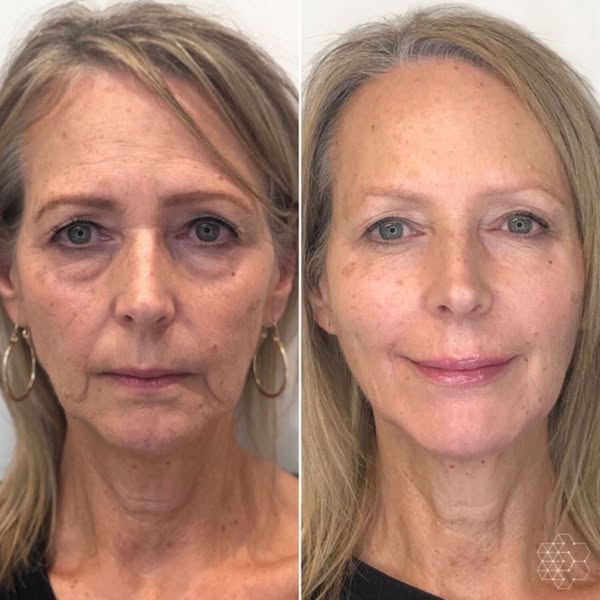
It's noon. You check your reflection. The concealer that looked fine at 7am has settled into the hollow under your eye — and it's now making the shadow more visible than bare skin would have.
You have done this before. You are going to do it again tomorrow.
You are someone who has been more thorough about this than most people would ever bother being. That is not the problem. The problem is that for years you have been solving the wrong problem — and nobody told you there was a different one.
"The shadow under your eye is not dark circles. It is not pigment. It is the shadow cast by a hollow — by the absence of volume beneath your skin — and nothing that works above the skin was ever designed to address it."

The shadow under your eye is not a dark circle. It is a hollow casting a shadow. These are not the same diagnosis.
Same symptom. Completely different cause. The entire makeup industry treats them as one problem. They are not.
Dark circles are pigment — discolouration sitting in the skin itself. Colour correctors, brighteners, vitamin C — the right tools for that problem. A hollow is structural. There is physically less volume beneath the skin than there used to be, and the depression it creates casts a shadow. The shadow is not the problem. The hollow is the problem. The shadow is just what the hollow looks like from the outside.
You cannot colour-correct structural absence. You can cover it temporarily — but the moment that product moves (and it will), the shadow is exactly where it was. This is also why the tutorial works on the creator and looks wrong on you. She has pigmentation. You have a hollow. Same concealer. Different anatomy. Different result.
"You have been applying a pigment solution to a structural problem. Not because you did anything wrong — because no one told you they were different problems with different answers."

The concealer settles into the hollow by noon because of physics. No formula change was ever going to fix that.
Liquid and cream products settle toward the lowest point available. If there is a structural depression beneath your eye, everything you apply above it will, over hours, be pulled toward it by gravity and facial movement. It doesn't matter if it's the $8 one or the $68 one. It doesn't matter how you set it. The hollow is there. The concealer finds it. Every time.
The only way to stop the concealer settling into the hollow is to remove the hollow. Not cover it differently. Remove it. Which means addressing what's causing it — and that happens 1.5mm below the surface, in a layer no makeup product has ever been designed to reach.
Under your skin, below the dermis— there are fat pads. Compartments of fat cells at your cheekbones, under your eyes, lips, temples. The architecture of your face. When the cells that fill these pads go quiet, the pad deflates. The skin above has nothing to rest on. The hollow forms. The concealer settles into it. Every day. Until something changes the hollow itself.

Colour correctors cannot correct a shadow cast by structure. They correct pigment. When there is no pigment, there is nothing to correct.
You studied the colour wheel. You found the right shade. You applied the peach corrector. The shadow was still there — now slightly peachy, but still there. This is not a failure of the product or the theory. Colour correctors work exactly as designed. They correct skin pigmentation. Your shadow is not pigmentation. It is cast from a depth below the skin. No colour can cancel a shadow created by structure.
The peachy-strange result wasn't wrong technique. It was the correct product responding to the wrong diagnosis. Your anatomy required something different — something the colour wheel was never built for.

The tutorial looked wrong on you and right on the creator because you have different anatomies. Not different skill levels.
You followed every step exactly. Same products, same sequence, same amount. It looked wrong. You watched it again. You tried a different creator with the same technique. Wrong again, in the same specific way. The conclusion your brain draws — after the fourth try — is that there's a skill here you haven't developed. That conclusion is wrong. The technique was developed for pigmentation. You have a hollow. Those are different anatomical situations and they require different solutions.
Some of you have started wearing glasses not because you need them — but because they cover the area without the noon collapse. I see this more than you might expect. Women who have quietly started managing around the symptom because they've tried everything and concluded the fault is theirs. It isn't.
The formulation that reaches the fat pad layer is now available outside a clinical setting.
Korean-formulated. 5% Volufiline + Salmon PDRN. Applied at home in 30 seconds.

Your skin is healthy. The problem lives 1.5mm below it — in a layer nothing in your makeup bag or your skincare shelf can reach.
You may have tried eye creams too. The skin around your eyes improved — texture, surface quality — but the hollow was completely unchanged. Same reason. Every concealer and primer operates at the epidermis. The most penetrating skincare actives reach the dermis. The fat pad layer, where the hollow originates, sits 1.5mm below the base of the dermis. An anatomical boundary that water-based formulas — which includes virtually every eye cream, serum, and concealer — cannot cross.
Your skin is fine. The problem is happening below the reach of both aisles you've been standing in. 1.5mm. That's the distance between everything that didn't work and the answer.
In a 56-day clinical study, Volufiline at 5% concentration produced measurable structural volume gain in all participants — documented by ultrasound imaging, not self-reported feeling. The mean gain was 2.2%. The top-responding quarter showed 8.4% structural increase.
For context: one round of hyaluronic acid filler typically delivers 1–3% measurable volume. The top-responding Volufiline users achieved that — without a needle, without a clinic, over 56 days at home.
Most Western products that list Volufiline on their label include it at 0.5% to 1% — enough to claim the ingredient, not enough to replicate the clinical result. The study used 5%. Concentration is not a detail. It is the difference between something that works and something that appears on an ingredient list.

The fat pad cells that used to fill that hollow are still there. They didn't leave. They went dormant.
The cells didn't disappear. They went quiet. And quiet is not the same as gone.
The fat pad cells beneath your eye that used to support the skin above them — they didn't die. They stopped receiving the biological signal that told them to stay full. Often, estrogen. When estrogen drops — in perimenopause, often like a cliff not a slope — the instruction to stay full stops reaching the cells. The pad empties. The hollow forms.
But dormant is not the same as gone. The cells are still there, in exactly the same places, waiting. Damage is permanent. Dormancy is not. The hollow does not have to be permanent — which changes what is possible entirely.

There is one compound designed to reach that layer and send the signal back. It has never been in anything sold in a beauty store.
Volufiline is a lipid-based compound — not water-based, which is why it can cross the 1.5mm barrier that stops everything else. Once there, it binds to fat pad cell receptors and activates the pathway that signals them to refill. The clinical study measured results via ultrasound imaging — mean structural volume gain of 2.2%, top-responding quarter at 8.4% in 56 days. One round of filler delivers 1–3%. From a balm. At home. Without a needle. Combined with PDRN — a clinical wound-healing molecule that reactivates dormant fibroblasts — both layers of the same problem are addressed simultaneously.
Most products listing Volufiline use 0.5–1% — a tenth of the clinical dose, enough for the label, not enough for measurable results. The study used 5%. Clarae uses 5%.
Women using this describe the same progression: around week two, the concealer starts sitting differently. By week four they're using less. By week six or eight, someone asks what concealer they're using — because it looks better than it ever has.The technique didn't change. What changed is what the concealer has underneath it. The concealer finally has something to rest on.
Tomorrow morning you're going to apply concealer. It will look fine at 7am. By noon it will have settled into the hollow. Not because you chose the wrong product. Because the hollow is still there.
That loop doesn't have to continue. But it will — every single morning — unless something reaches the layer where the hollow actually begins.
You found out the actual problem. You are someone who, when given the right answer to the right problem, does something about it. That's why you're still here.
“The concealer finally works when there’s something underneath it.”

$29.95
for two
The formulation that reaches the fat pad layer. Korean-formulated. 5% Volufiline + Salmon PDRN.
GET CLARAE — BUY ONE GET ONE · $29.95 →60-Day Money-Back Guarantee