

7 Things You Need to Know If You Actually Want to Fix Your Under-Eyes
You’ve tried the creams, the serums, the concealer tricks. Nothing has worked. Here’s the reason why — and what 30 years of clinical research says about the one approach that’s different.
Your Eye Cream Isn’t Working. And It’s Not the Brand’s Fault. It’s Physics.
Every under-eye product — from the $7 caffeine serum to the $180 luxury eye cream — is built on the same premise: apply active ingredients to the surface of your skin and hope they reach the deeper layer where the actual damage lives.
They can’t get there.
Your skin has an outermost barrier called the stratum corneum. Its job is to keep things out — and it’s very good at it. Research has shown that molecules above a certain size simply cannot pass through this barrier and reach the dermis underneath. They sit on the surface. They make your skin feel smooth for a few hours. And then they evaporate.
Here’s the problem: most of the active ingredients in your eye cream are far too large to penetrate.
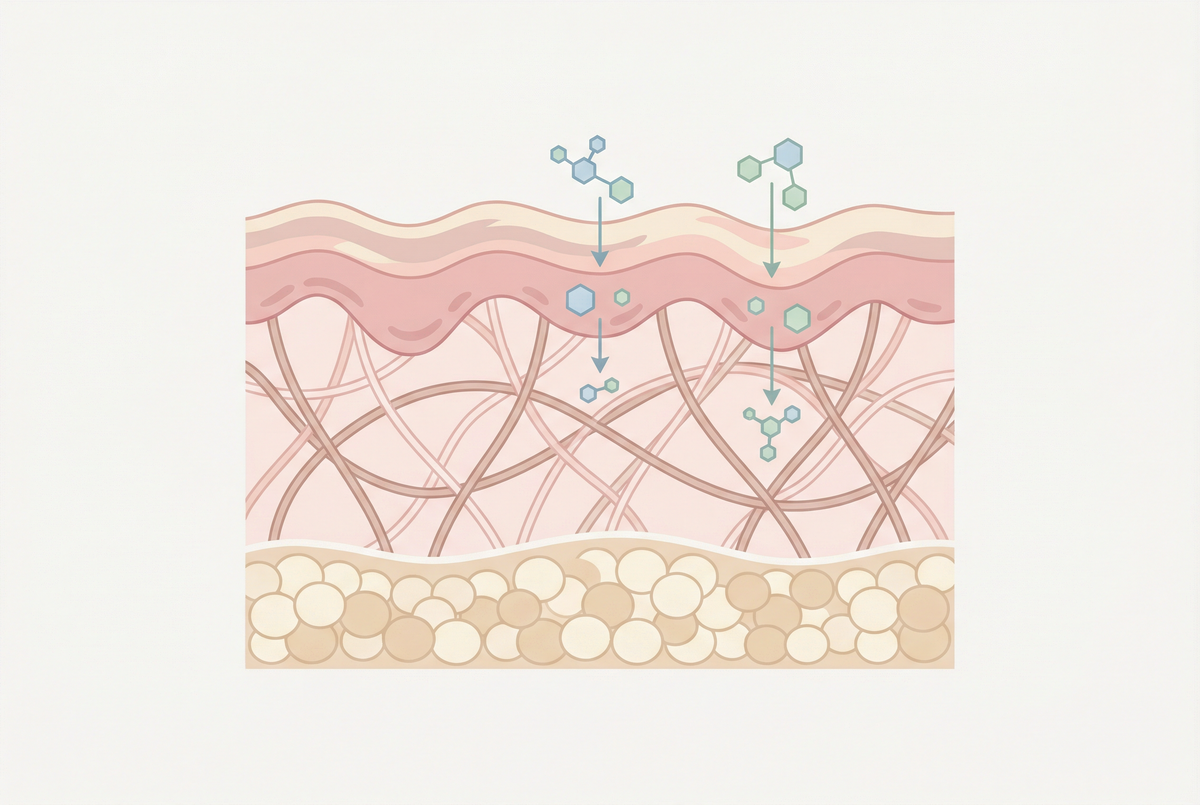
Hyaluronic acid — the most common ingredient in eye creams — is roughly 2,000 times too large to reach your dermis. It attracts water to the surface, makes your skin feel temporarily plumped, and evaporates by noon. That’s what most “hydrating” eye creams actually deliver: a few hours of surface water.
Retinol is small enough to penetrate. But the under-eye area is the thinnest, most sensitive skin on your face. The concentrations needed to actually rebuild tissue cause irritation most people can’t tolerate — so most eye creams use amounts too low to do anything structural. Enough to list on the label. Not enough to change your face.
Caffeine penetrates easily — but all it does is temporarily shrink blood vessels. Thirty to sixty minutes of mild improvement, then gone. It doesn’t build anything. It doesn’t repair anything. It constricts, and then it wears off.
The beauty industry has known this for over two decades. The science showing that most eye cream ingredients can’t penetrate the skin barrier has been published since 2000. But “temporary surface hydration” doesn’t sell as well as “clinically proven results” — so they keep marketing products that their own formulation scientists know can’t reach the layer of skin where under-eye aging actually occurs.
What’s Actually Happening Under Your Eyes Isn’t What You Think
Most people think dark circles and bags are caused by tiredness, dehydration, or not using the right products. That’s only a small part of the picture.
What’s actually happening is structural collapse.
The skin under your eyes is approximately 0.5mm thick — compared to 2mm on your cheeks. It has almost no oil glands, minimal fat padding, and a fragile network of blood vessels sitting right beneath the surface. It endures 15,000 to 20,000 blinks per day. No other area of your face takes that kind of constant mechanical stress.
After 30, your body produces approximately 1% less collagen each year. That annual loss hits the under-eye area first and hardest — because there’s less structural margin to lose. The collagen scaffolding that holds your skin taut degrades. Fat pads shift or shrink. The dermis physically thins.
The result: hollowing that creates shadows. Translucent skin that shows blood vessels underneath. Crepey texture. Bags. Not because you’re dehydrated or tired. Because the structural foundation beneath your skin is gradually disappearing.
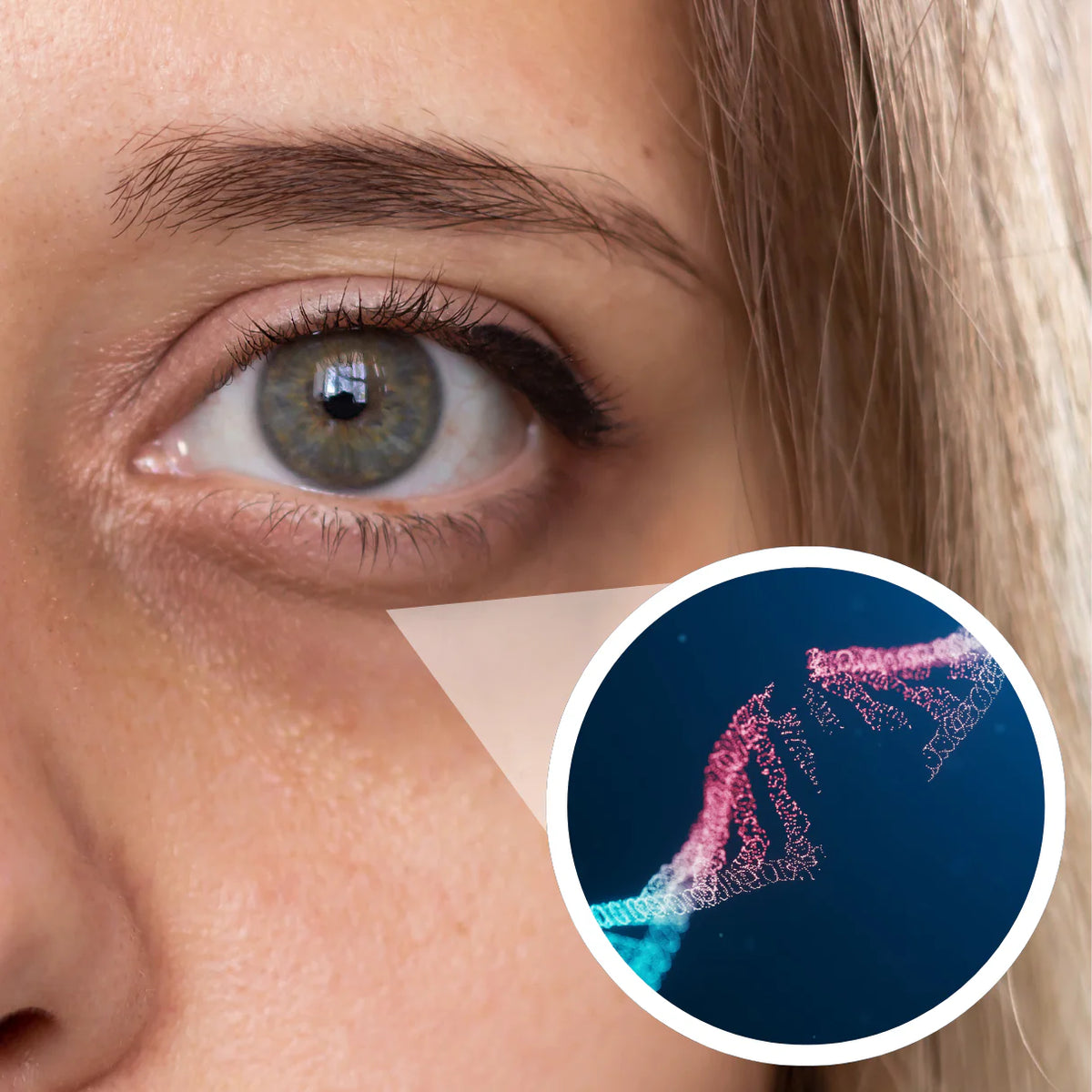
Here’s the part most people never hear: the cells responsible for producing collagen under your eyes are damaged. Years of UV exposure, oxidative stress, and the mechanical strain of blinking have impaired the DNA in your dermal fibroblasts. Damaged cells produce collagen at only a fraction of their normal capacity. They’re not lazy — they’re broken. No topical product that merely “stimulates” a broken cell will produce structural change. You need to repair the cell itself.
Your Under-Eyes Have Been Telling You Something. You Just Didn’t Know What.
Every one of these is a signal that structural damage — not surface dehydration — is the real problem:
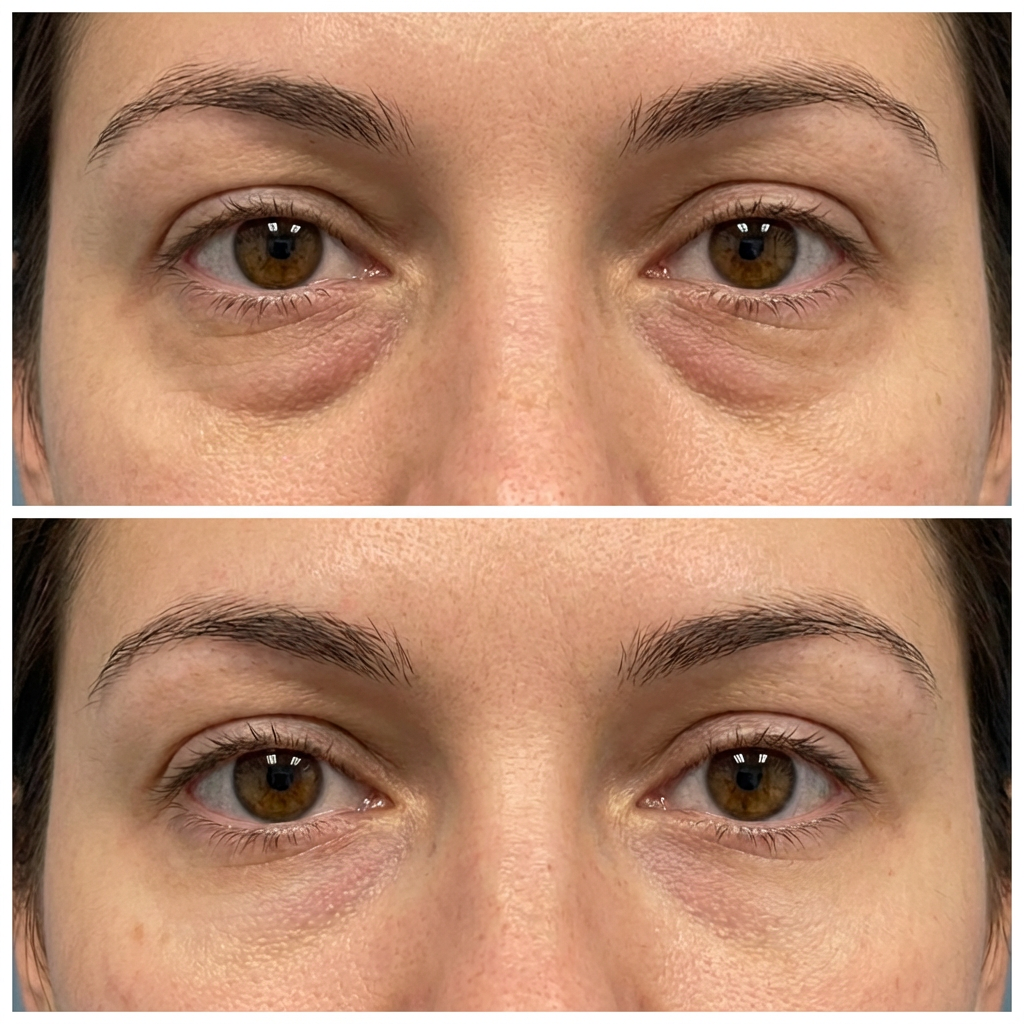
These aren’t random frustrations. They’re predictable symptoms of a structural problem that no surface-level product can address. Your under-eyes have been telling you the real diagnosis. Now you know what it means.
You’re Not Testing Different Solutions. You’re Testing the Same 3 Mechanisms With Different Labels.
This is the insight that changes everything.
Look at every under-eye product you’ve ever tried. The caffeine serums. The peptide eye creams. The hyaluronic acid patches. The retinol treatments. The vitamin K creams. The jade rollers. The LED masks. Different brands, different price points, different marketing stories.
But only 3 mechanisms between all of them:
That’s it. Every eye cream, serum, patch, and treatment you’ve tried is some combination of these three approaches. Different actives. Different concentrations. Different packaging. Same ceiling. Same disappointment.
None of these mechanisms can repair damaged cells in the dermis. None of them can regenerate lost collagen. None of them can reverse structural thinning. They treat the surface symptoms of a problem that lives underneath — and the surface is not where your under-eyes need help.
This isn’t a failure of effort or knowledge. It’s a failure of category. You’ve been looking in the right place with the wrong class of solution.
There’s a 4th Mechanism. It Works Differently From Everything Else.
While Western skincare has been cycling through the same three mechanisms with different labels, Korean dermatology clinics have been using a fundamentally different approach for under-eye treatment: PDRN — polydeoxyribonucleotide.
PDRN isn’t a new trend. It’s been used in clinical medicine since 1994 — in Italy, South Korea, and Japan for wound healing, burn treatment, and tissue repair. The injectable form is one of the most common under-eye treatments performed in Korean clinics today. Over 30 years of medical use. Over 80 peer-reviewed publications.
The mechanism works through a biological pathway that nothing in the traditional skincare market replicates:
Finds and targets damaged cells
PDRN fragments bind to specific receptors that are highly expressed on damaged skin cells. Healthy cells barely respond. Damaged cells respond strongly. PDRN goes where the damage is — it doesn’t waste effort on areas that don’t need repair.
Triggers the cellular repair process
Once bound, PDRN activates a signaling cascade that promotes new blood vessel formation (better circulation = less dark pooling under thin skin) and stimulates the cells to begin dividing and repairing. The cells wake up.
Provides the raw building blocks
PDRN fragments are recycled by your cells as the actual molecular material needed for DNA repair. Once the cell’s DNA is repaired, it resumes producing collagen at normal capacity — not the reduced 18–24% that damaged cells can manage.
Tissue regeneration — not temporary masking
The result is genuine structural rebuilding. More collagen = thicker skin = less hollowing = reduced shadows. Measured by ultrasound imaging in clinical trials. Maintained between treatments. Progressive over 8 weeks.

The critical distinction: every other under-eye product tries to stimulate damaged cells to work harder. But damaged cells can’t respond — their DNA is impaired. PDRN repairs the cells themselves. Once repaired, they produce collagen normally. That’s the difference between asking a broken machine to run faster and actually fixing the machine.
Can it work topically? PDRN fragments are specifically processed to a size range optimized for skin penetration — unlike full-size polynucleotides which are too large to cross the barrier. In a hydrogel patch format that creates a sealed environment and maintains 20–30 minutes of sustained contact with the skin, the delivery conditions are fundamentally different from a cream that absorbs in 30 seconds. Contact time + occlusion + optimized fragment size = meaningful delivery to the dermis.
72-patient trial, 12 weeks
ultrasound confirmed
6-week study
Measured with imaging instruments. Not self-reported questionnaires.
Every Year You Wait, the Problem Gets Harder to Fix
Collagen loss isn’t steady. It’s compounding.
By 35, you’ve lost about 5% of your collagen. Barely visible — maybe some early shadows, a slight change in texture. By 40, 10% gone. Now the hollowing is real. Concealer isn’t sitting right. People are starting to comment. By 45, 15% gone. The structural damage is plainly visible. Fillers start entering the conversation. Surgery starts entering the conversation.
Every year without intervention doesn’t just mean one more year of the same problem. It means the starting point gets worse. The repair job gets bigger. The results take longer because there’s more damage to reverse.
This isn’t a scare tactic. It’s biology. Collagen degradation is a one-way process unless you intervene with something that actually stimulates regeneration at the cellular level. Surface hydration doesn’t slow it. Caffeine doesn’t slow it. Even retinol, at the concentrations most eye creams use, doesn’t meaningfully slow it in the under-eye area.
Clinical data confirms this: participants who started PDRN treatment with moderate damage saw faster, more complete improvement than those who started with severe damage. The mechanism works in both cases — but starting earlier means the repair pathway has less ground to cover. The best time to start was before you noticed the problem. The second best time is now.
The Answer Was Never a Better Product. It Was a Different Mechanism.
That’s what most people get wrong about under-eye treatment. We assume the problem is that we haven’t found the right cream yet. The right brand. The right formula. The right price point. So we keep trying. Keep spending. Keep hoping the next one will be different.
The answer was never a better product. It was a different category of biology entirely.
An ingredient that doesn’t just stimulate damaged cells but repairs them. A molecular size that doesn’t just claim to penetrate but actually can. A delivery format that doesn’t just feel nice but creates the conditions for meaningful absorption. And a body of clinical evidence measured by ultrasound imaging — not opinion questionnaires.
That’s what PDRN represents. Not a better eye cream. Not another variation on hydration, caffeine, or peptides. A 4th mechanism that works through a biological pathway nothing else in the market replicates — backed by 30 years of medical use and dozens of peer-reviewed studies.
Your under-eyes aren’t broken. Your effort wasn’t wasted. Your hope wasn’t naive.
Your products were just too big to fix them.
| Traditional Eye Products | PDRN Patches | |
|---|---|---|
| Mechanism | Surface hydration / vasoconstriction | Cellular repair + collagen regeneration |
| Penetration | Most actives above skin barrier threshold | Optimized size + occlusive patch delivery |
| Duration | 2–4 hours (temporary) | Progressive, maintained between uses |
| Evidence | Self-assessment questionnaires | Ultrasound imaging + clinical measurement |
| Typical annual cost | $300–$1,200/year | ~$350/year (maintenance) |
| vs. Under-eye filler | $800–$2,400/year + risks | ~$350/year, zero documented risk |
| vs. Surgery | $4,500–$8,500 one-time, irreversible | $29 to start, progressive, no recovery |
You’ve Tried the Creams. You’ve Tried the Concealers. Try the Mechanism That Actually Reaches the Damage.
Clinical-grade PDRN patches. 500+ ppm concentration matching peer-reviewed research. Hydrogel delivery for sustained contact with the skin. The only topical approach clinically shown to repair cellular damage and regenerate under-eye tissue.
$29 for 8 pairs. 8 weeks to see structural results. Then maintenance.
After everything else you’ve spent on products that couldn’t reach your dermis — $29 to try one that can.